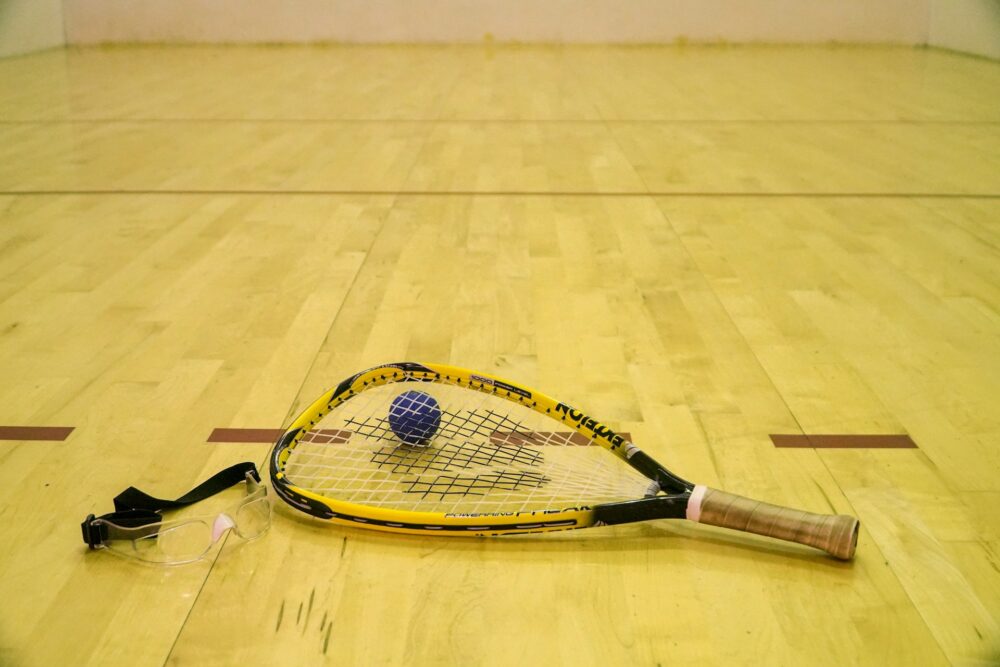
It’s a photo from college, before my husband and I married; I believe I’d just gotten my wisdom teeth out. I’m in our university’s racquetball courts, where he, my then-boyfriend, would play in tournaments. Let’s just say I wasn’t really tournament material.
In the photo, my racquet is about to connect with the blue ball. My curly ponytail whirls about my head. My face is pure, gritted determination.
The funny part? I’m flat-footed. It’s one of those snapshots that captures something true about me.
You would have seen the same thing at our wedding, when I flung my bouquet over the top of the entire crowd of single women, so they all ran twenty feet behind them, where my flowers slid down the wall.
My kids saw it the year we purchased them a baseball bat and a handful of tennis balls to practice with. When it was my turn at bat, my cheeky preteens naturally all moved in from their fielding positions, thinking I wouldn’t make it far.
“You’re gonna want to move back out,” my husband counseled them. “She’ll whiff it a few times, but when she connects, it’ll fly.”
Exactly this happened. I missed his first three pitches, but the third sailed over my kids’ heads.
Yeah, it felt good.
Skill Rather than Power
In a way, it’s much of how I approach life: Powerful. Muscular, even. But at least when it comes to sports, and sometimes relationships, skill and nuance weren’t my default. For a long time, anyway.
I might wield control or authority or immediate action. And sometimes, these are needed!
But some of the most effective, loving, and wise responses to others approach with skill rather than power.
I think of my husband attempting to teach me to play golf. Turns out whacking the thing with all my might was neither the way to get the ball farthest nor closest to the hole.
I needed, once again, to work smarter. Not harder.
Parenting Smarter, Not Harder
I sensed something similar this weekend when I learned something about one of my teens that meant we’d need to have a talk. My impulse–emotional, fearful all the way–was to confront on the spot, chiding them.
It was the old “Connect with the ball: force, not skill” method.
But now, after twenty-one years of parenting, I’m thankfully a little better at listening to the Holy Spirit. He helped me pull back to the bigger picture with this child; what he’s been working on in their heart.
Sure, there was a chance my head-on confrontation or brandishing of authority, could work. Or there was a chance it could oppose the big picture God’s meticulously crafting in my child.
In my experience, he tends to act less like a grenade, more like a scalpel.
I need surgical parenting, Not reactive, shock-and-awe parenting.
Read “AM I A CONTROLLING PARENT?”When Good Relationships = Restraint
Wise relationships, in my experience, require remarkable restraint.
In our emotions, agendas, and desires for our kids, we have to be able to immediately dissect our impulses.
- Which part of this emotion is legitimate, and even holy?
- Which part might be corrupted, or outside of God’s proper order?
- How is God seeking to connect with me in this moment? In this moment, what’s it look like to love him, and my neighbor (e.g. my child)?
Nuance, Thoughtfulness, and the Gifts We Don’t Give
I’ve thought about how God identifies himself as a good gift-giver. He’s a God of nuanced, perfect gifts for us (James 1:17).
Or which one of you, if his son asks him for bread, will give him a stone? Or if he asks for a fish, will give him a serpent? If you then, who are evil, know how to give good gifts to your children, how much more will your Father who is in heaven give good things to those who ask him! (Matthew 7:9-11)
I assume that sometimes, God gives me not what I ask for, but something better. (I don’t know about you, but I think about some high school crushes, and thank God for unanswered prayers.)
Sometimes, the best, nuanced gifts I give my child aren’t the obvious, hit-it-out-of-the-park gifts. Some of the best gifts are what I don’t give them.
Maybe it’s like the difference between giving your kids ten cardboard boxes to make imaginary vehicles over the next two years rather than a ride-on motorized Jeep for the driveway (not throwing shade if that’s your jam).
What gifts—work, risk, grit, resilience, consequences, struggle, creativity, imagination—benefit our kids more than comfort?
What gifts could your marriage use–that aren’t, say, about emotional domination, but about listening, receiving, and thoughtful navigation? (Don’t miss Could You Be Emotionally Dominating Your Relationships?)
This week, may you work smarter, not harder. May you be more skilled in your relationships than I am as an athlete.
And every now and then, hit it out of the park.