 This past weekend filled my (okay, crusty-ish, bordering on burnout) little heart with happiness: Three-fourths of my kids were home.
The guys all went camping. (I happily stayed at home in fuzzy socks and watched some Friday Night Lights.) My son cooked stew. We played trivia for big-kid prizes. We went out for coffee in pairs. Burgers and pho and birthday cupcakes were heartily consumed. Snowflakes fell in the size of quarters.
Ahhh.
This is also where honesty requires I tell you I am quite tired. Some of the week—as it so often is with family—was very emotionally involved. We worked out small-ish conflicts, engaged in truthful conversation, and I did a lot of listening, which I needed to do.
That is to say, attempting emotional health in parenting can be exhausting.

Emotional Health in Parenting: Not a Holy Add-on
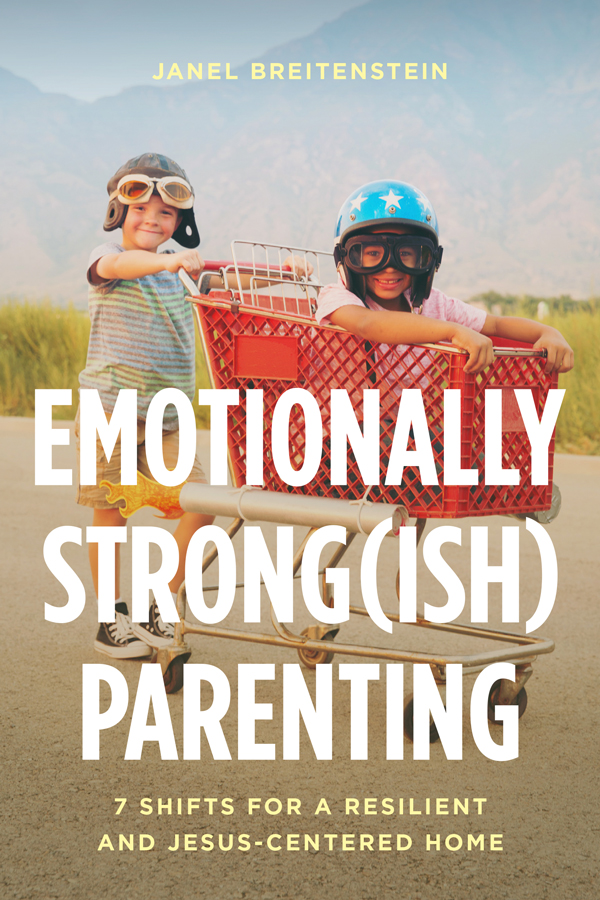
Something else very cool happened this week: I launched Emotionally Strong(ish) Parenting: 7 Shifts for a Resilient and Jesus-Centered Home (NavPress). Insert cartwheels, fireworks, and confetti! A book-baby is born—and I am really excited about its message.
READ FIRST CHAPTER (SCROLL DOWN HERE)
Now, it’s possible you may have picked up the idea that emotional intelligence is pink and squishy. That it’s nice for people who want to sit around in group therapy and maybe sing “Kumbaya” while shaking a rain stick.
But what about the rest of us, who want to get stuff done for the Kingdom of God?
Maybe you’re wondering,
• Is “emotional health” actually self-infatuation or self-indulgence—when instead we should be denying ourselves, forgetting ourselves?
• Is emotional intelligence really a psychobabble term for going soft in places where Christians should retain fortitude despite how we feel?
• Aren’t our hearts deceitful and sick (Jeremiah 17:9), so maybe we shouldn’t be listening to them at all?
I wager the opposite, on all counts.
We all parent out of our own health or dysfunction, from truth or from our trauma. Usually both.
Emotional Health in Parenting: The Must-Have
If we are to deny ourselves and live Jesus’ way, we must take the time to discern—to listen for—the healthy or dysfunctional responses within ourselves. We need an examined life, one undeceived by our hearts.
In order to “let love be genuine” (Romans 12:9), we must intimately decipher which parts of our hearts are authentic and which are false.
In other words, following Jesus demands that we grow toward emotional health. And parenting has demanded that my husband John and I prioritize soul-level healing and health.
Intriguingly, John Calvin asserts that the “sum of true wisdom” is via “the knowledge of God and of ourselves.”
He goes on, “Without knowledge of self there is no knowledge of God.” Otherwise, separating our inner selves from God, we offer a “false show of righteousness.”
We’ve all known Christians whose “righteousness” doesn’t seem to address what’s really going on inside. Sadly, they can be some of the most offensive representations of Jesus on the planet.
That’s because spiritual health invites us not just to know about God but to usher him into our deepest parts.
We bring unresolved questions and uncomfortable emotions into our worship: “All that is within me, bless his holy name!” (Psalm 103:1, emphasis added). We can’t just leave the bad stuff outside, sniveling or grabbing a smoke.
JOIN MY FREE ZOOM EVENT TUES., NOV. 10!
Why Emotional Health in Parenting Matters: Exhibit A
Let’s look at emotional intelligence in your own kitchen, with your own squirrelly kids. Think about your own preteen, perched on a kitchen barstool after school, munching jalapeño kettle chips Cookie Monster–style, crumbs flying.
Maybe you mention a verse you’ve been thinking about, and the obnoxious potato chip eating falls silent.
Preteen: “Yeah, I’m not sure if the Bible is true.” Their pupils slide to you, eyeing your reaction.
If you’re like a lot of Christian parents, inner sirens may nearly drown out the sounds of your child’s resumed munching. Stress sweat pricks your armpits.
Is this kid deconstructing? Deconverting? I gotta fix this. STAT.
Consider a few of your knee-jerk response options:
a. Dust off those apologetics answers from college. Get ready to defend the faith and train your child in the evidence for Christianity. Order all available Lee Strobel books, requesting that your child give a book report on each. Raise the issue frequently until your child’s heart softens.
b. Correct your child immediately: “Sweetie, God’s Word is a lamp unto our feet and a light unto our path. What you’re thinking is simply a lie. Do you have sin in your life? Let’s pray.”
c. Commence guilt-tripping: “I can’t believe you’d turn your back on our faith.” (Pro tip: Watch out for emotional manipulation, demanding sympathy for yourself—Focus on my world!— rather than engaging with your child’s emotions, concerns, and experience.)
Or consider that you can pause for a beat and respond more like this:
d. Put on your unshocked, curious, come-as-you-are face.
Within yourself and to God, acknowledge your fear. Ask for God’s help, trusting him with your child’s faith journey.
Sit down to listen, refraining from interrupting or offering easy answers.
Gently ask questions to understand the issue beneath your child’s presenting concern: “Exploring doubts and questioning what you believe takes courage. Thanks for trusting me. Can I hear more?”
Starting, not Stopping, the Conversation
When curiosity rather than quick correction leads these conversations, it creates doorways to, rather than exists from, deeper faith.
One analysis of Barna data suggests that kids who feel safe bringing questions and doubts to their parents may be up to four times as likely to remain engaged in church as young adults than those raised in environments where doubt is discouraged.
Four times as likely.
Your emotional health in parenting isn’t a nice add-on.
It’s key to raising lifelong disciples.
How you handle this moment can set the table for you and your child to dialogue about faith questions and doubts for decades.
Or it can successfully shut your child down, thanks to responding with the “right” answers, like those pseudosolutions above in options a, b, and c.
Those emotionally impulsive (not resilient) responses can sever communication and effectively send your child who-knows-where for more satisfactory answers.
You might unintentionally communicate that unlike what we witness in the Psalms or in, say, Elijah or John the Baptist, real Christians don’t give doubts any legitimate attention.
Will you be a conversation starter or stopper?
Repeating what You Don’t Repair
Most of us parent the way we were parented—until the pain of staying the same finally outweighs the pain of changing (or until you open your mouth at 4:02 p.m. on a Tuesday and one of your parents falls out).
Some of us are still yelling because our dads yelled or perfect-performing because our moms guilted us. Or are emotionally constipated because feelings were minimized or seen as the enemy to godliness in our house.
Think about it: Your obstacles with your own parents are likely emotional health issues.
So yeah, I’m passionate about emotional health in parenting.
I’d love to hear your thoughts on ideas like these, as well as your burning questions about emotional health in parenting. Let’s get the dialogue started.
Emotionally healthier parenting may indeed be exhausted, and may mean taking the longer, much harder way at times.
But surely, for thriving, God-loving families, the juice is worth the squeeze.