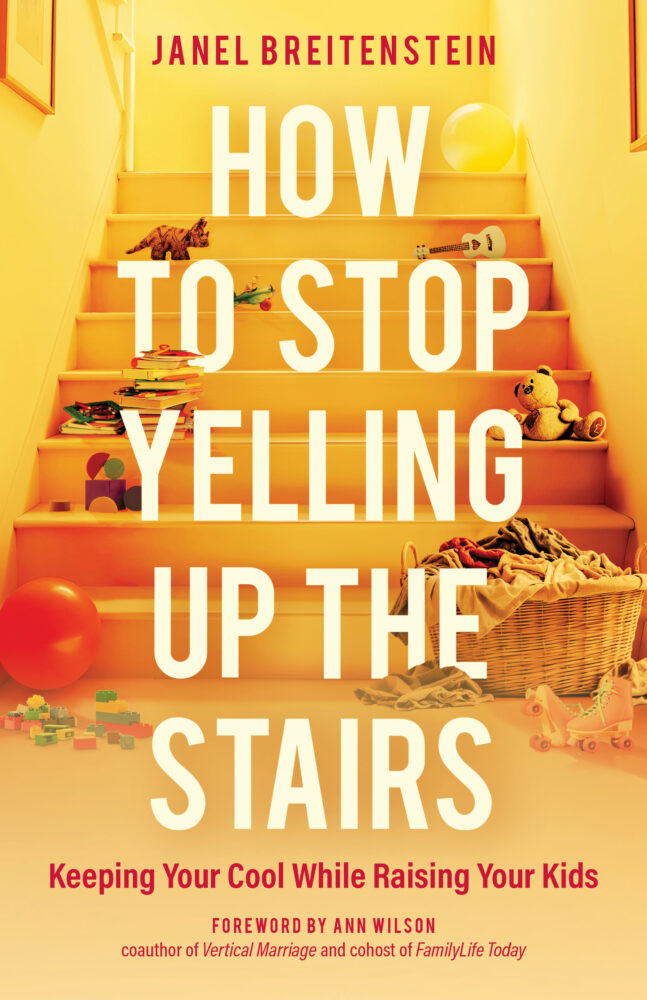
I’m so jazzed about today’s post: I finally get to reveal the cover for How to Stop Yelling Up the Stairs: Keeping Your Cool While Raising Your Kids, now on preorder for its April 21 release. YAHOO!
Not that any of us struggle with mom-anger. You’re reading this for a friend, right? Kinda like I certainly wrote this from a bunch of interviews and not personal experience…
Readers, I am actively looking for a book launch team for the three-week period around the launch–which will include some fun, some cool prizes (think: Amazon gift cards), and an electronic advance copy of this book!
***Are you interested? (Yes, you!)*** Please enter your information in the feedback form on my About/Contact page; in the body, you only need to type “BOOK LAUNCH.” This should take you about 30 seconds. I’ll reach out to you soon!
Read the first chapter free by subscribing on the right sidebar of this blog (even if you’re already a subscriber).
Meanwhile–here’s an excerpt from How to Stop Yelling Up the Stairs. Would you pray with me for God to use this book in families?
I Should Just Keep Driving, Right?
When a check engine light appears on one of the dashboards in Casa de la Breitenstein, my husband’s and my own protocol— after the compulsory despairing groan and fist shaken skyward— means hauling the car to one of the shops in town. For no cost, they plug their handheld computers into my car. These magic machines spout certain codes the mechanic can interpret.
It’s your O2 sensor. Or it’s an electrical issue. Or your car is now a three-thousand-pound paperweight. To drive it out of this parking lot will only require polishing off your retirement account.
Without the code, even an accomplished mechanic might not know where to start.
Jay Stringer, in his book on unwanted sexual behavior, poses a startling truth: “One evening of deliberate curiosity for your sexual fantasies will take you further into transformation than a thousand nights of prayerful despair.”
He’s not encouraging us to chase sexual fantasies out of curiosity, but to be curious about why, and by what, we’re allured. I find so much wisdom in getting curious about our temptations and failures in anger too—our attempts to blame, shame, control, and escape. Behavior, as it is said, makes sense in context.
If we’re not sure why, for the love of Mike, we— or our kids— are acting a certain way, it’s possible we need more information.
And that curiosity about our own sin is one of the first steps God asks of us, no?
Jesus characterizes helping someone else with their portion of the conflict as delicate work— like getting a speck out of their eye. So he says, “You hypocrite, first take the log out of your own eye, and then you will see clearly to take the speck out of your brother’s eye” (Matthew 7:5).
And there is a log, Jesus asserts. Our own sin simply alters perspective— our way of viewing the world (Matthew 6:22-23).
Relationships that mirror God’s require this brand of humble, self-searching heart (Micah 6:8). They’re the kind of relationships that actually work, rather than wrecking everything around us as if we were swinging around a fence post.
Decoding Mom-Anger
So allow me to flash back a few years—to a situation where I couldn’t decipher the code. I couldn’t shake a sense of resentment, which bored into me like a toothache.
A colleague had taken me for granted. At one point, my husband, bless his pea-pickin’ heart, gently pointed out I was gripping my anger past its due date.
I was nursing it, confident in my righteousness. Even the frequency of my anger toward this person indicated I was losing God’s perspective on who they were and how he saw them.
Another friend of mine says when you give a five-hundred-dollar response to a fifty-cent problem, there’s a bigger issue beneath.
I had to ask: Why did this still clutch at me?
In situations like this one, I’ve learned to ask questions about the “code” my heart is throwing.
- What lies beneath this reaction?
- What’s the important thing I truly long for (starting with the large categories of power, approval, comfort, security)? What might feel trampled on?
- Is this playing on a painful previous circumstance—punching a past bruise?
- Is this the culmination of other events? In the last day or week, what situations have tipped my sense of equilibrium?
- I’ve learned to be curious about my anger without passing judgment at first. The big red rubber stamp of judgment can prevent that curiosity, and, therefore, what God wants to show me in the middle of my anger.
Next on CSI: [Insert Your City]
Get forensically curious about anger, like a crime scene investigator sifting through clues. Thinking alongside the Holy Spirit, examine all the evidence.
- What raw, unfiltered thoughts galloped through my mind? What can I learn from those about where my heart is/was?
- What emotions did I feel, and what phrases were being said or actions were taken?
- What moments or phrases keep rocketing around my brain? Why are those sticking with me?
Don’t forget to consider evidence from the other person too.
- What emotion did I see the other person display, and when?
- Thinking charitably and acknowledging what I don’t know, why do I think they may have responded that way? How well have I truly empathized with their experience? How might God respond to that person compassionately?
- What desire of theirs might I or this situation have trampled on?
- How might God have me respond to what they want? (Tip: Working out a compromise is one thing. But when it comes to you or your kids, “Don’t feed the idols!” is typically wise advice.)
Then, seek to ask at least three levels of questions. That line of questioning could look like this:
- Deep: Why am I angry? Why are my responses lasting so long and with such deep emotion?
- Deeper: What’s my unmet desire beneath this situation? What feels robbed from me?
- Even deeper: Why does it feel so important? Am I looking to the right place to meet that desire?
- Deeper still: What do I think the other person might be protecting, and why? (Hold this loosely, without passing judgment on the other person.)
- Deepest: What values do this person and I share regarding this situation? What would we both agree is important?
What’s the Fight Beneath the Fight?
The book of James outlines what churns beneath the presenting symptoms of those conflicts. Remember: Your kids and your spouse (if you’re married) have their own idols.
What causes quarrels and what causes fights among you? Is it not this, that your passions are at war within you? You desire and do not have, so you murder. You covet and cannot obtain, so you fight and quarrel. You do not have, because you do not ask. You ask and do not receive, because you ask wrongly, to spend it on your passions. (James 4:1-3)
In my scenario with my colleague, conflict was erupting even though the other person had no idea. (Considering the power imbalance between us, healthy channels for confrontation felt few at the time without making a career-limiting move.) Their passions were headed one way, mine another.
And in our own ways, we were taking life from each other rather than giving it—a frequent attempt at a solution, James suggests, when we can’t get what we want. Even though a lot of my life-taking (for example, my disparaging judgments and assumptions) was happening in my own thoughts.
James seems to suggest these passions tinge our prayers too, making them about our own willful desires and interpretations, rather than God’s ways.
Honestly, I don’t remember what I prayed for at this moment in my career. I imagine that even if I prayed for my coworker’s “heart to be soft,” it might have been more for my selfish ambition than truly caring about my friend.
I might not have really desired at my core God’s will to be done “on earth as it is in heaven” or been seeking first God’s kingdom (Matthew 6:10,33).
(What I pray for can be one of those forensic clues about my anger— and my idols: Lord, here’s what I think will make my life sing.)
The only antidote to the idols in my idol-making factory of a heart? To trust God rather than myself. To turn the control and honor back to him. (As Elisabeth Elliot has said, “Fear arises when we imagine that everything depends on us.”)
It’s where I must acknowledge the lie—and deny it: the apparent, immediate fulfillment I’m depending upon to make my life sing.
Yet which I will always find lacking.
In this work-related conflict, beneath my emotions was a craving for significance. To feel seen in what seemed like a season when I felt anonymous in my own life. For my life work, particularly amid the thankless monotony of raising four young kids (which felt like nine?), to matter, even eternally.
Were these worthy goals? One hundred percent.
But I find that in Scripture, order matters to God. Relational Wisdom 360 points out that often in anger, an idol is born— something that wants to steal our allegiance to God and his ways.
What’s beneath your anger?






1 Comment
Lynn Morgan-Taylor - 7 months ago
Book launch