You will never (ever) find me writing a book about potty training. I was terrible at it, perhaps in part because at one point, I had four kids four and under. I was just trying to only have two in diapers rather than three.
In fairness, all my children, now young adults, go to the bathroom on their own. Success!
But I did learn one principle that carried over into my anger management (stay with me here). In potty training, kids first have to learn, I just went.
The next step is, Hey! It’s happening! Right now!
And finally, This is about to happen! I need to find a bathroom.
Pro tip: The child who never realizes they have already gone or are about to go is among the least likely to make it to the potty in time, and you should carry around clean pairs of trousers, or seven, and consider forgoing other life activities for the time being.
Maybe you can see the parallels: In anger management, we’re doing the work (and sometimes regression) of “potty training” our
anger.
From, Whoa, I just lost it. I would like to control that and not just make a royal mess.
To, This is happening. I am losing my . . . control right now.
To finally forecasting, I’m about to lose it. I’d better do what I need to so I don’t.
Bonus: Parenting is going to hand you a lot. of. practice. Welcome to Holiness Boot Camp. (Maybe bring extra pants.)
I’m saying that addressing our anger requires looking it in the eye— so we can eventually understand just how and why it happened, and head it off before it happens in the future.
Ready to potty-train your anger?
I just lost my…control.
A well-known business axiom points out that “what gets measured, gets managed.”
So first, start noticing when you feel angry–and its intensity on a scale of 1-10.
Maybe consider those moments when you thought, This is why some insects eat their young. Or when you considered grounding your child until they either turn twenty-six or Halley’s Comet reappears.
Then, get curious.
- How often is it happening?
- What kinds of events does it happen around? When we’re late. When the kids are complaining. Around bedtime. When I’m hormonal. These are some of your triggers.
- If going into fight/flight/freeze is like flipping a circuit breaker–what factors make yours more or less likely to flip? When I haven’t gotten a full night’s sleep. When I’m hungry or hot. When I’m already irritated with something else.
I’m losing it right. Now.
This is where an understanding of brain structure comes in handy.
When you feel out of control, your prefrontal cortex (PFC) goes “offline”—and (imagine some or all your four fingers flipping up) you “flip your lid,” disintegrating your prefrtonal cortex from the rest of the brain—kind of like unplugging the control center.
Your own preschooler- brain is now calling the shots, creating either chaos or rigidity. At this point, Neuropsychologist Dan Siegel points out, you’re not living in harmony within yourself or with others. You’re not “connected,” in more than one sense of the word.
It takes twenty to sixty minutes for your PFC to come back in control after fight/flight/freeze. You need that so you’re more likely to respond to your child and not discipline reactively and unwisely.
Suffice it to say the fight/flight/freeze version of myself is not the holiest version of me. That version of me, often not in step with the Holy Spirit (Galatians 5:25)–because again, I’m not very connected to myself, my kids, nor him–often becomes more about my kingdom than God’s (Matthew 6:33, James 1:20).
As counselor Brad Hambrick points out, in anger, we all think we’re Jesus turning over tables in the temple.
Hambrick points out that in Matthew 21, after Jesus turned over the tables, the blind and lame flocked to him. “In Jesus’ most expressive moment of anger, the most vulnerable felt protected and attracted. Not scared.”
Is that how my kids, in their vulnerability, feel following my displays of anger—even toward them?
Help yourself move out of fight/flight/freeze by
- Turning on some music and dancing.
- Getting a glass of water.
- Going on a walk (may need to grab the stroller!).
- Going into a dark room to settle your sense of overstimulation.
- Changing your location— even moving to a different room, or standing
if you’ve been sitting.
I’m about to lose it.
Once you’ve begun this journey of noticing and curiosity, you’ll likely find it easier to head anger off at the pass.
One of my key strategies in this has been noticing my body. For a long time, I didn’t know I was terrible at this. (To the point that in college, I was dangerously close to an eating disorder. People, it takes a significant lack of body sensitivity to starve oneself.)
Think: What does anger feel like in my body—before, during, and after?
Are you aware of when your body feels jittery or anxious? (What happens?) Do you know when your respiration is increasing, or you have that “trying to keep my control” feeling?
For so long, I believed poor theology that devalued and lacked awareness of my body and emotions. I’m frequently underfed and underrested—decidedly the less self-controlled, loving version of me.
I often sped past what seemed like the “un- Christian” emotions like fear, shame, or sadness. As I once read on social media, feelings are like kids: They shouldn’t be driving solo, but you also shouldn’t stuff them in the trunk.
And in that “stuffing,” I rocketed beyond any emotional warning signs I could have tended before shotgunning those feelings toward my children.
How to Stop Yelling Up the Stairs: Book Giveaway!
When I start talking about parent anger, it’s amazing at how the room transforms into a confessional of sorts. These “You, too?!” looks populating the faces of even the meekest mothers. I call it the Fight Club.
I believe anger can not only be something we start to control–but that conflict can become a massive opportunity in our homes to replay what God did in his conflict with us.
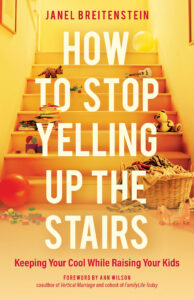
My own experiences, and what it took to claw my way out, birthed How to Stop Yelling Up the Stairs: Keeping Your Cool While Raising Your Kids. And as of April 21, it’s launched! (I am so jazzed.) The feedback has been tremendously encouraging; even Publishers Weekly likes it. YAY.
With all the questions for groups and personal reflection, it could even be fun for a summer Bible study. Because when moms get to gether, it’s a chance to lift shame.
I’m giving away a free copy of the book here on the blog, and one on Substack! (Grab the first chapter for free on this blog, by subscribing on the right-hand side.)
To enter the free giveaway, just leave a comment on this post. If you’d like to double up on your entry, share the book or this post on social media, and leave a note about where you shared. The giveaway will close at midnight on May 25.
If you purchase a copy (yeah! Do it!), enter your purchase information at HowtoStopYellingUptheStairs.com for some free goodies.
More than your comments or shares–I’d love your prayers for the ministry of this book, and that God would move powerfully in families.
In every moment, every emotion, may he have his way in our homes.
Like this post? You might like
How to Stop Yelling Up the Stairs EXCERPT–and Help Needed!