Recently, I returned from a mind-blowing trip to Asia, in part because of my husband’s and my role with Engineering Ministries International—which provides design services to organizations in developing countries around the world that love Jesus and help the poor. Think hospitals, schools, water projects.
I hope to write more about this trip at some point. But suffice it to say that when I returned to America, the soil of my brain freshly turned over by the poverty I’d seen, Amazon Prime Day was upon us.
On my phone, I keep an ongoing list of toiletries or other odds and ends my family could probably use soon, but maybe not at full price…? Not to mention a wish list of things I would enjoy or would make our lives easier.
So as I form the list over time, there’s a delay of gratification there. And for the last few years in purchasing clothing, with a few exceptions, I’ve decided to restrict my clothing shopping to ethical sources.
But even after years in Africa, and a family value of simplicity (or is it simplicity-er?) it’s amazing how fast my house fills up with stuff. Ayayay.
My own self-justification for more stuff kinda embarrasses me. And contributes to me knowing the UPS people (for Amazon returns) by first name.
That is to say, I feel the complicated relationships of human beings and the things that belong to us.
The Stuff beneath Your Stuff
In 2021, a dark year to me because of stuff going on with my teens, I began to tackle our house’s pockets of clutter.
I printed labels, developed a cozy relationship with the Goodwill dropoff, purchased sizable quantities of matching Mason jars. Perhaps in a tribute to my mother’s fierce DNA—a renowned and revered organizer—I discovered eliminating chaos of my external world did soothe some of the internal hurricane.
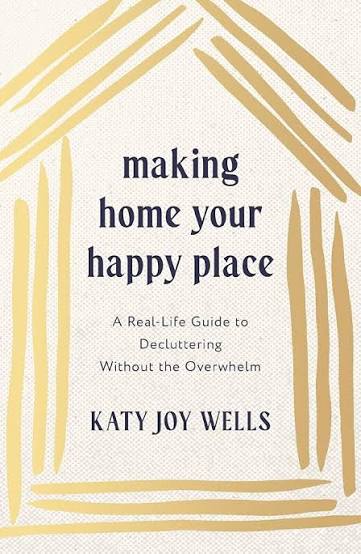
It’s one reason I’m grateful for the premises beneath Katy Joy Wells’ Making Home Your Happy Place: A Real-Life Guide to Decluttering without the Overwhelm.
Wells not only offers simple, doable steps for decluttering—like the Five Basic Steps of Decluttering a Kitchen—but also addresses the heart issues of why we long for, accumulate, and hold on to the things we do.
I’m reminded of a friend’s church who labored together to help a hoarder clean out her home. The woman was tremendously grateful.
And had soon reacquired a home stuffed to the gills, along with nine cats. (Should it make me feel better that right now we only have the one dog?)
Because, my friend explained, they never addressed her heart issue.
Trauma therapist Adam Young wisely connects that “your idolatry grows in the soil of your pain.” (Seriously. Every human on earth could write this down.) Your past story explains your present behavior.
What’s Keeping You Cluttered?
So Wells, too, looks at mindsets keeping us stuck in clutter. She helps the reader with 4 S’s:
- Spot the mindset.
- Soften it. Look at, say, your scarcity or “but what if someday” thought patterns with compassion and curiosity, rather than bulldozing them.
- Shift it, nudging your heart toward truth. So in response to, “What if I regret this?” You can think, “If I need it again, I trust myself to find a solution.” To “But it still works…” you can answer, “Just because it’s useful doesn’t mean it’s useful to me.”
- Step forward—”where mindset meets movement.” You let go of one just-in-case item you’ve been keeping for years. You write down an item you have that does the same thing as the one you’re considering getting rid of.
The 4 Kinds of Clutter
But Wells knows we’ve got more than “scarcity” clutter lying around. There’s
- Superficial clutter. There’s no fear, memories, or guilt; life just got busy, and you don’t have a system. Half-full cosmetics, reusable shopping bags, kitchen gadgets you haven’t used in two years. (I even have a system organizing a ton of electronics chargers…which I am thinking as I type, Not sure anyone knows what devices those go with. Probably time to say adios.)
- Sentimental clutter that holds stories, moments, and milestones. You’re deciding “which parts you’re ready to release with love.”
- Identity clutter. “This clutter shows up in the gap between who you thought you’d be, and who you think you should become”—you used to be creative. You should work out more.
You’re getting the idea how this could be an intensely helpful book not only for our houses, but our families, no?
Why We “Add to Cart”
I love, too that Wells tackles chapters like
- How to Get and Stay Motivated,
- Helping Kids Take Ownership, and
- (I’m looking at you, Amazon Prime Day) Break the Shopping-and-Clutter Cycle.
Because, as she points out, we “add to cart” out of boredom, Stress. Loneliness. A craving for control. A need to feel seen or valued. And maybe other ways we shop emotionally.
I like that she suggests asking,
- What am I really hoping this gives me?
- What do I think it will solve or soothe?
And do I really think what I crave can be found with this item?
Jesus reminds me “one’s life does not consist in the abundance of his possessions” (Luke 12:15)—easy for my brain to tsk-tsk about “rich” people; tough to apply to my soul’s thirsty gathering of life and healing from virtually any other unsatisfying source (Jeremiah 2:13).
BOOK GIVEAWAY! Making Home Your Happy Place
So I’m giving away one copy of this book on my blog, and one on my Substack (feel free to enter in both places!).
TO BE ENTERED, just leave a comment on this post, or share this post on your social media and tag @JanelBreit, by 12 AM MST on Friday, July 24, 2026.
Here’s to our homes being more simply satisfied.




5 Comments
Amy - 3 months ago
Really need to declutter! Would love to win this book!
PNGLynn - 3 months ago
Yeah, so I struggle with the “What if I get back down to that size someday” dilemma. “If I toss those smaller outfits, what will I wear then?” I could probably benefit from that chapter! 😉
Stephanie - 3 months ago
I struggle with clutter and get overwhelmed easily when I go to declutter. I would definitely read this.
Marina - 3 months ago
I’d love to read this book.
Lollipop Cheong - 3 months ago
The delayed wish-list approach makes decluttering feel preventive, especially when pausing before purchases reduces future overwhelm.